
Lost bone doesn't have to mean lost hope for implants. Dr. Sumit Firke uses 3D CT-guided bone grafting to rebuild the foundation your implant needs, precisely, safely, and predictably.
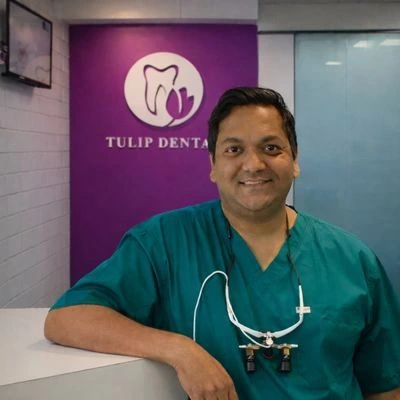
With 10+ years in practice and 500+ implants placed, Dr. Sumit Firke focuses on complex implant cases, including patients who have been told implants are not possible due to bone loss.
Every graft is planned using 3D CBCT imaging before surgery. Dr. Firke calculates exact graft volume, selects the appropriate material, and plans membrane placement digitally, then executes with surgical precision.
When a tooth is lost, the jawbone begins to resorb (shrink), starting within weeks. If too much bone is lost, there is no anchor for a dental implant. Bone grafting adds bone volume back, creating a stable site for implant placement.
Dr. Sumit Firke uses graft materials that act as a scaffold, your body grows new bone into the graft over 3–6 months, replacing it with your own regenerated bone. A protective membrane is placed over the graft to guide this process.
Exact bone volume and density measured from a 3D CT scan. Graft type, volume, and membrane requirement calculated precisely before surgery begins.
Bone graft material placed at the defect site under local anaesthesia. A collagen membrane is placed over the graft to protect it and guide bone regeneration.
3–6 months of healing. New bone forms into the graft scaffold. Once healed, Dr. Firke places the dental implant into the regenerated bone site.
Dr. Firke selects the graft procedure based on your 3D scan findings, the location of bone loss, and your implant plan.
Performed at the time of tooth extraction to prevent the initial collapse of the socket walls. Preserving the socket immediately after extraction minimises bone loss before it begins, the ideal time to graft.
Done at extractionRebuilds lost bone width and/or height at an implant site. Used when the bone ridge has already resorbed after tooth loss. Creates the volume needed to securely anchor an implant.
Rebuilds width & heightFor the upper back jaw (posterior maxilla), where the sinus cavity sits above the implant site. A sinus lift adds bone below the sinus floor, enabling posterior upper implant placement without penetrating the sinus.
Upper back jawIndividual Assessment Required: Dr. Firke selects the appropriate graft type and material based on your 3D CBCT scan. Not all missing teeth require bone grafting. A consultation and scan is the only way to determine your specific needs.
No surprises and no hidden costs. Here is exactly how it works at Tulip Dental, Dombivli.
A scan shows exactly how much bone you have and where it is missing. Sometimes the answer is that no graft is needed at all.
Graft material is placed under local anaesthesia to rebuild the site. It is a shorter appointment than most patients expect.
The graft integrates with your own bone over 4–6 months, forming a stable foundation.
Once the site is solid, the implant is placed with proper support — which is what makes it last.
Have more questions? Dr. Sumit Firke answers queries on WhatsApp, usually within the hour.
Dr. Sumit Firke has helped patients rebuild bone and go on to get implants they were told were impossible. A 3D CT scan and honest consultation is the first step.
Patients travel from across the region to Tulip Dental, Dombivli